Carefully selected sources on women’s health and the FemTech market in Poland and globally.
YearAll years
TopicAll topics
45 resources in the library
Reports open in a new tab
SEXEDPL · Ipsos
Breast Health in Poland: I Don’t Have Time for Cancer
A report on breast cancer prevention and the gap between awareness and mammography uptake. It examines why women in Poland postpone screening despite understanding its importance and identifies ways to improve participation in preventive care.
A report on how women in Poland search for health information online. It examines online self-diagnosis, source credibility, health misinformation, and how digital content shapes decisions about medical consultations and treatment.
From margin to mainstream — The future of women’s health
PwC highlights that women’s health remains structurally underfunded and underprioritised despite its scale and influence, but closing this gap represents a significant multibillion-dollar growth opportunity as the sector moves into the healthcare mainstream.
Silicon Valley Bank’s report on venture capital, startups, innovation, and transactions in women’s health across the US and Europe. It analyzes roughly $2 billion invested in 2025 and the sector’s funding outlook for 2026.
The report shows that women’s health, despite affecting nearly half of the global population, receives only 6% of private healthcare investment. It identifies the sector as one of the largest untapped growth opportunities in healthcare, with potential extending far beyond reproductive health.
Follow the Exits: AOA DX Women's Health Report 2025
The first comprehensive report analyzing 25 years of exits in women’s health, documenting over $91 billion in realized value. It shows that women’s health is a mature, highly profitable market driving innovation in diagnostics, oncology, and chronic care, while also demonstrating strong capital efficiency despite historical underinvestment.
The Business Case for Accelerating Women's Health Investment
A report analyzing one of the most underfunded yet rapidly growing areas of healthcare, showing how sex-based insights are transforming markets, reducing risk, and unlocking value. It presents current market data, investor perspectives, and validated case studies, offering a clear roadmap for capital driving innovation and generating sustainable returns in women’s health.
Kearney · Flagship Pioneering · Mubadala · Novo Holdings
Accelerating Private Capital Investment in Women's Health
A report by Kearney, Flagship Pioneering, Mubadala, and Novo Holdings analyzing how private capital investment in women’s health can be accelerated. It shows that the sector is a large, underinvested, trillion-dollar market offering significant return opportunities while also addressing gaps in women’s healthcare access and improving health outcomes.
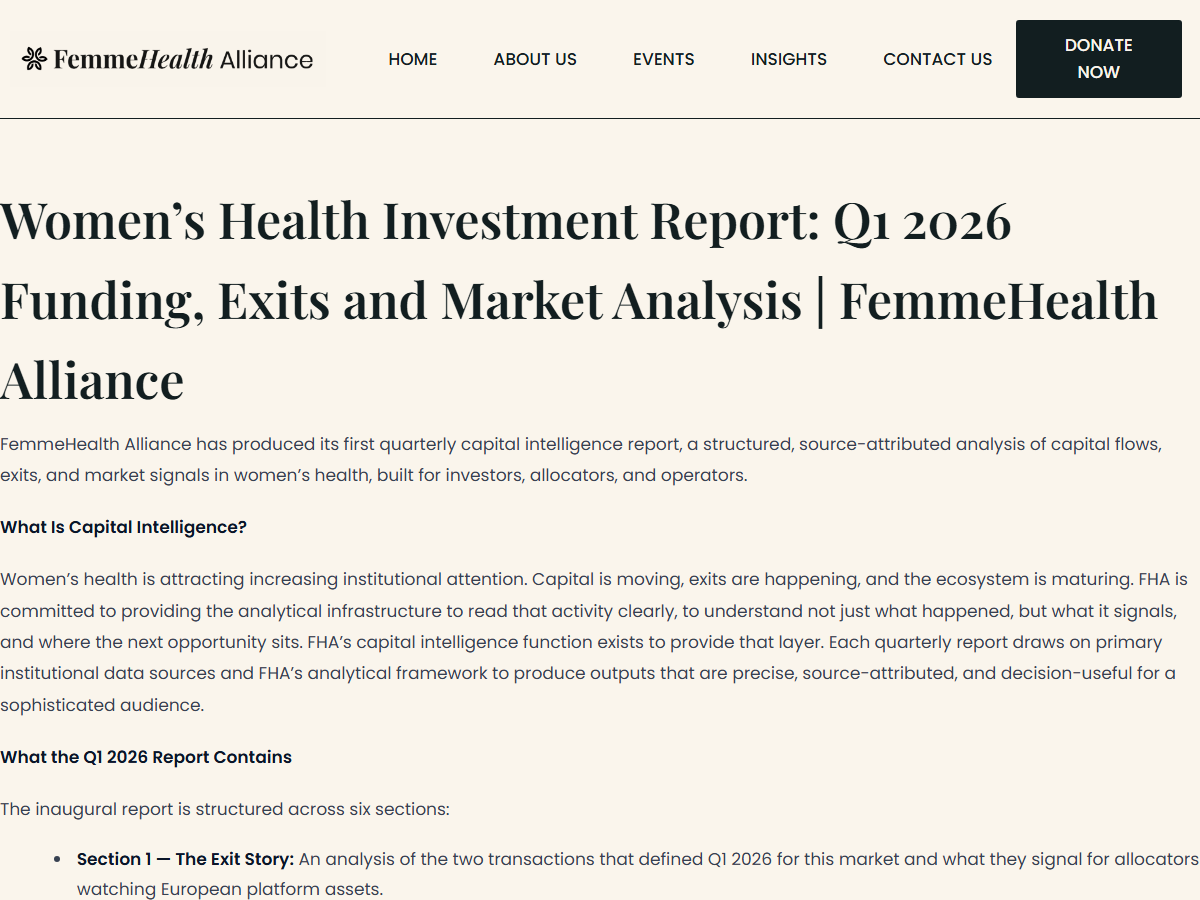
A quarterly analysis of capital flows, exits, and market signals in women’s health. The report examines the Q1 2026 funding environment, the European perspective, and implications for investors and operators.
CARE for Women: Investing in Care Delivery to Improve Women’s Lives and Livelihoods
A practical roadmap addressing gaps in women’s access, diagnosis, screening, and treatment. It examines the economic benefits of better care and presents the CARE framework for designing more effective clinical pathways.
World Economic Forum · Kearney Health Institute · Gates Foundation · Wellcome Leap
The Women’s Health Innovation Radar
A map of women’s health innovation from basic science through product development and patient access. It covers ten priority condition areas and highlights research gaps, underfunded stages, and opportunities for science and industry.
A review of a three-year UK programme supporting 43 FemTech innovations. It covers funding, commercialization, NHS collaboration, product development, and the impact of tailored support for companies at different stages.
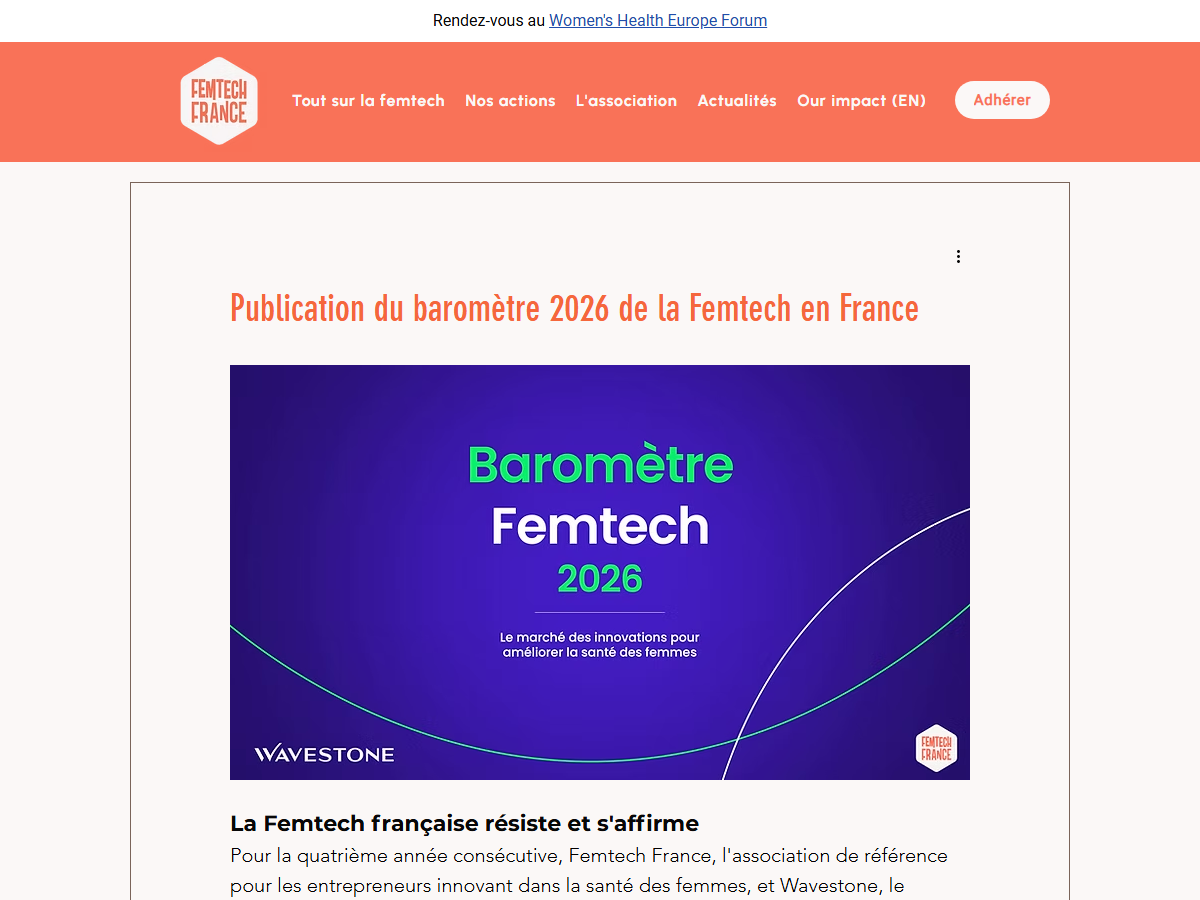
An overview of the French FemTech market covering around 200 active startups. It examines funding, revenue, profitability, employment, and business models across one of Europe’s leading ecosystems.
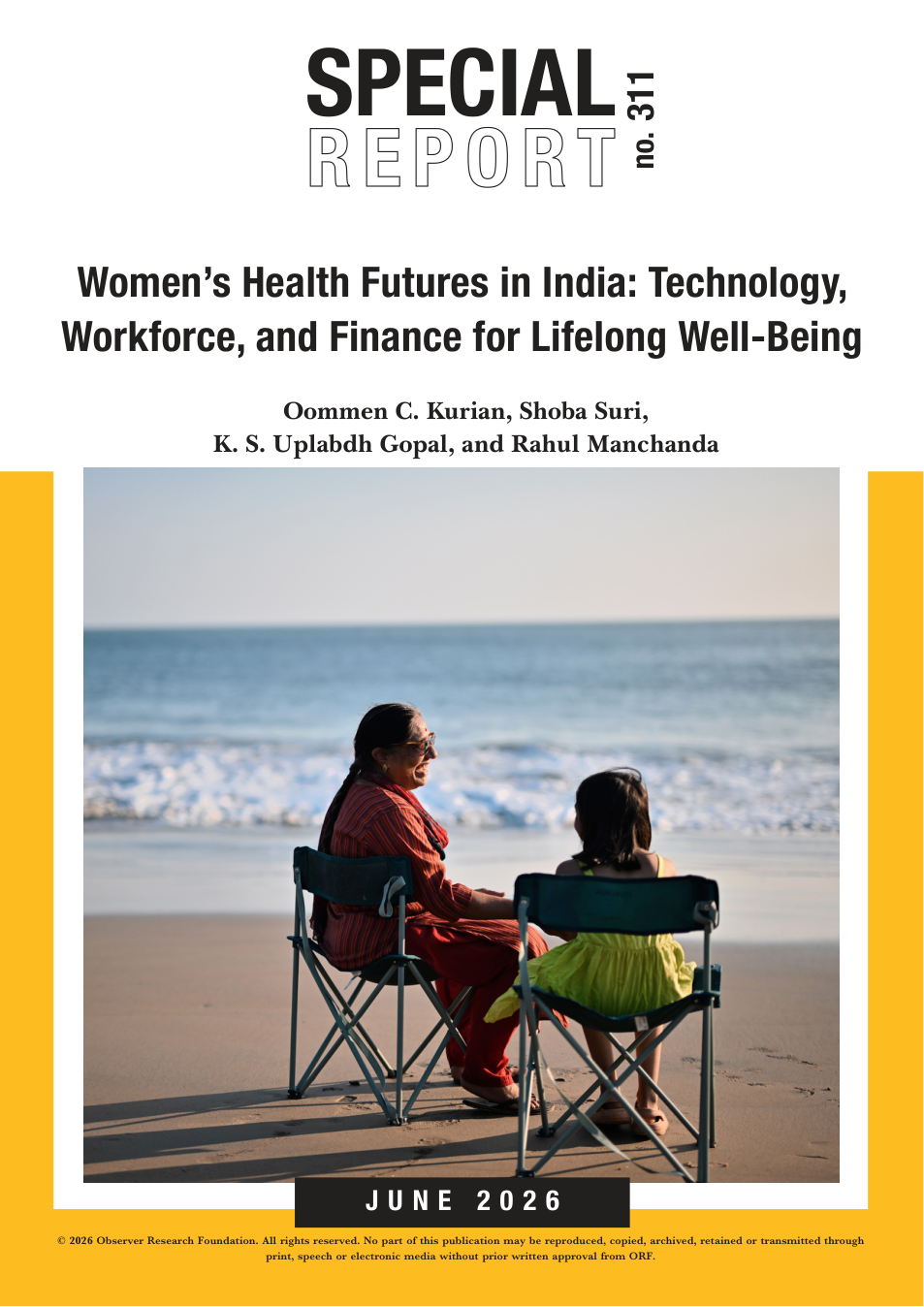
Women’s Health Futures in India: Technology, Workforce, and Finance for Lifelong Well-Being
A life-course analysis of women’s health in India. It examines AI and digital health, the healthcare workforce, women-led enterprise, financing, chronic disease, mental health, unpaid care, and ageing.
Closing the Women’s Health Gap: The United Kingdom’s £36 Billion Opportunity
An analysis of the women’s health gap in the United Kingdom and the potential health, social, and economic gains from closing it. The report estimates the economic opportunity at £36 billion.
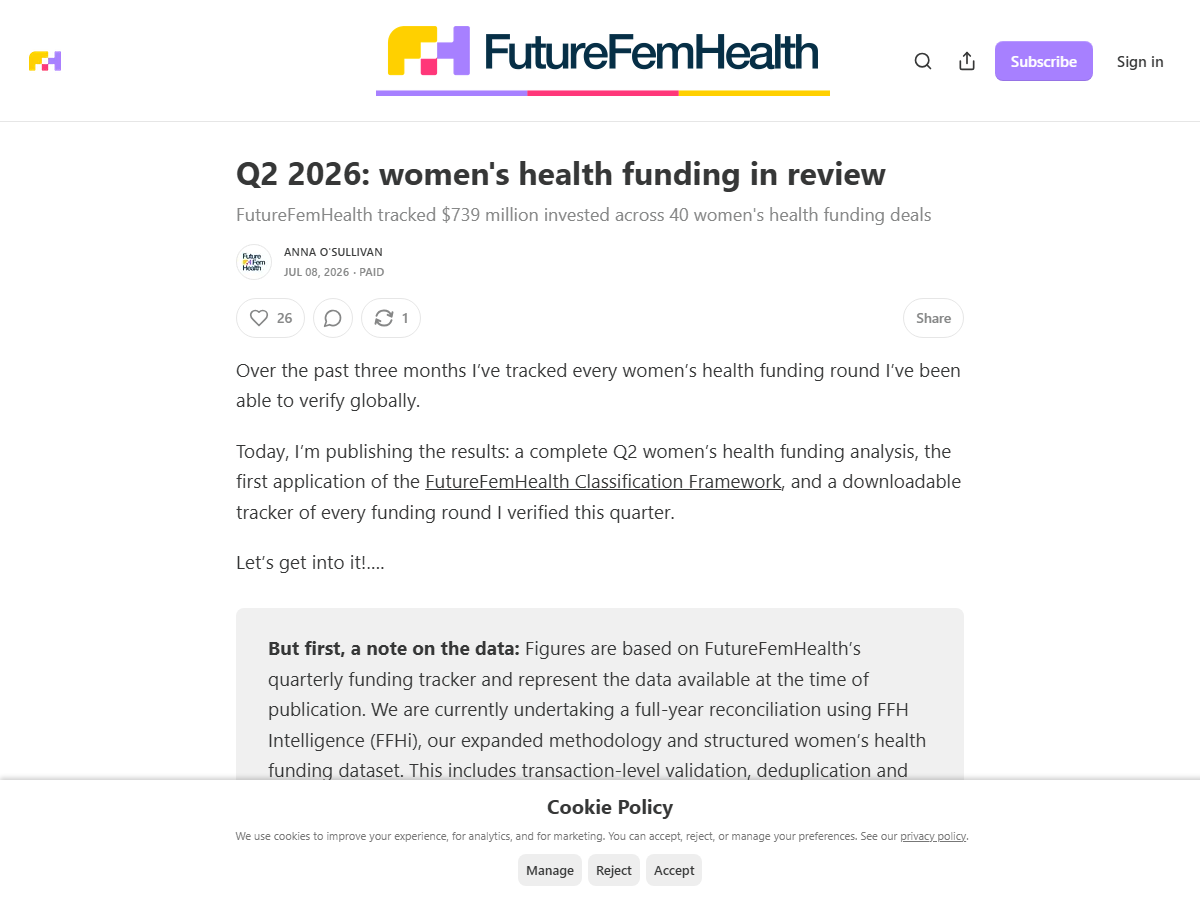
An analysis of 40 verified women’s health funding rounds totaling approximately $739 million in Q2 2026. It also applies a classification framework showing how different sector definitions affect investment data.
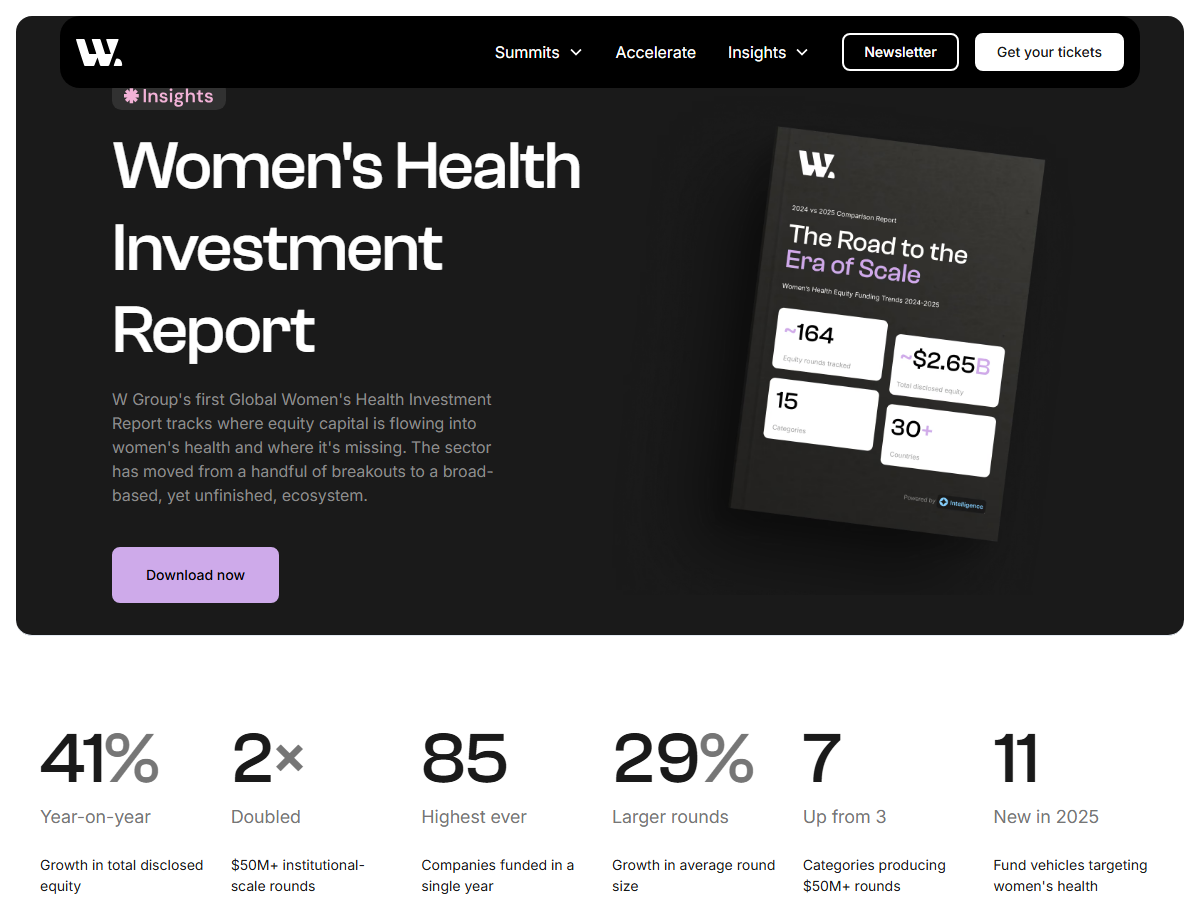
The Road to the Era of Scale: Global Women’s Health Investment Report
A global investment report based on more than 500 funding stories and 164 rounds across over 30 countries. It shows where capital moved in 2024 and 2025, which categories are growing, and what may constrain further scaling.
Coverage and Reimbursement Roadmap for Women’s Health Innovation
A guide to coverage and reimbursement pathways for women’s health innovations in the US, from product concept to patient access. It covers structural barriers and the self-pay, commercial payer, and public programme routes.
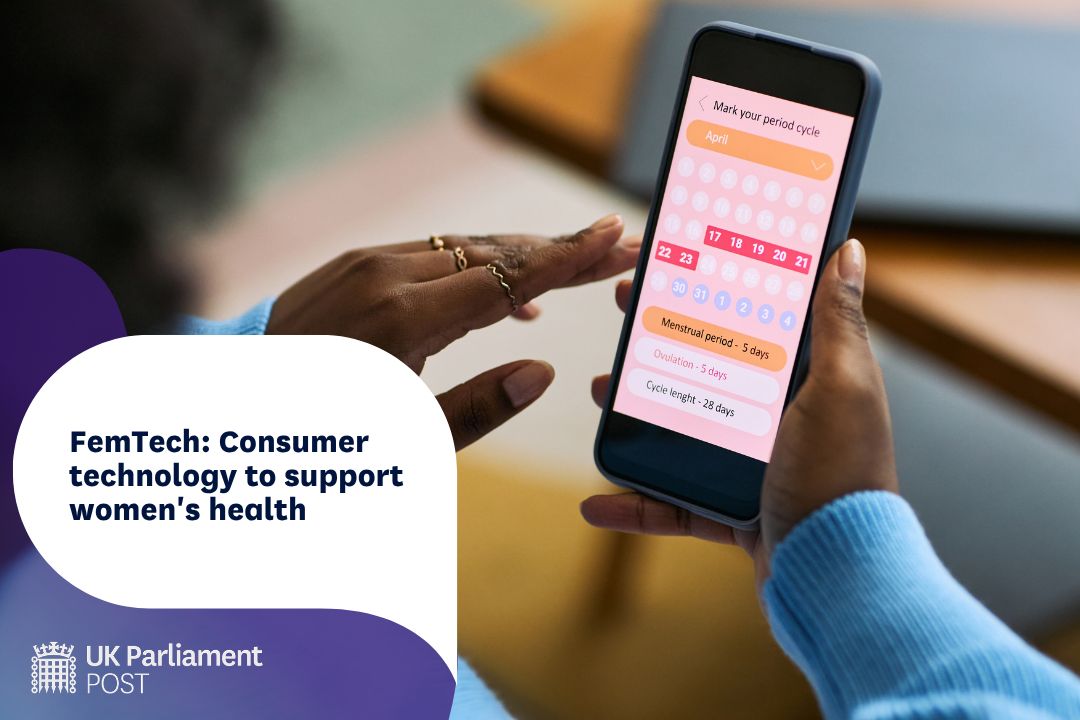
FemTech: Consumer Technology to Support Women’s Health
A parliamentary briefing on apps, software, and connected devices supporting women’s health. It reviews the evidence base, regulation, safety and data privacy, NHS adoption, and the risk of widening inequalities.
Censorship Revealed: One Year On — The State of Women’s Health Censorship in 2026
An analysis of restrictions and moderation affecting women’s health content on digital platforms one year after CensHERship’s first study. It shows that suppression continues to shape organizational communication and access to information.
2026 Overview of the Femtech Industry in Southeast Asia
An overview of the FemTech sector in Indonesia, Malaysia, the Philippines, Singapore, Thailand, and Vietnam. It covers market maps, business models, health categories, funding, and emerging regional ecosystems.
How a Limited Women’s Health Definition Inadequately Shapes Research, Investment and Care Delivery
A 31-page analysis of how narrowly defining women’s health around sexual and reproductive care shapes research, investment, clinical trial participation, benefit design, and access to care.
A global picture of women’s health and wellbeing based on experiences across 144 countries and territories. Year 5 examines access, prevention, and inequalities using 2024 data analyzed and published in 2026.
HRP’s annual report on its 2025 work to advance sexual and reproductive health and rights. It covers research, innovation, partnerships, and solutions that strengthen health systems and outcomes worldwide.
The second annual report on Spain’s FemTech ecosystem. It maps 64 active companies by category, geography, and technology type, and examines funding, investment, regulation, and women’s health policy in Spain.
This white paper frames menopause as a multisystem health transition and an underserved billion-woman market. It maps barriers in data, coding, and payment systems, alongside proven models, priority opportunities, and actions needed to make menopause care measurable, scalable, and investable.
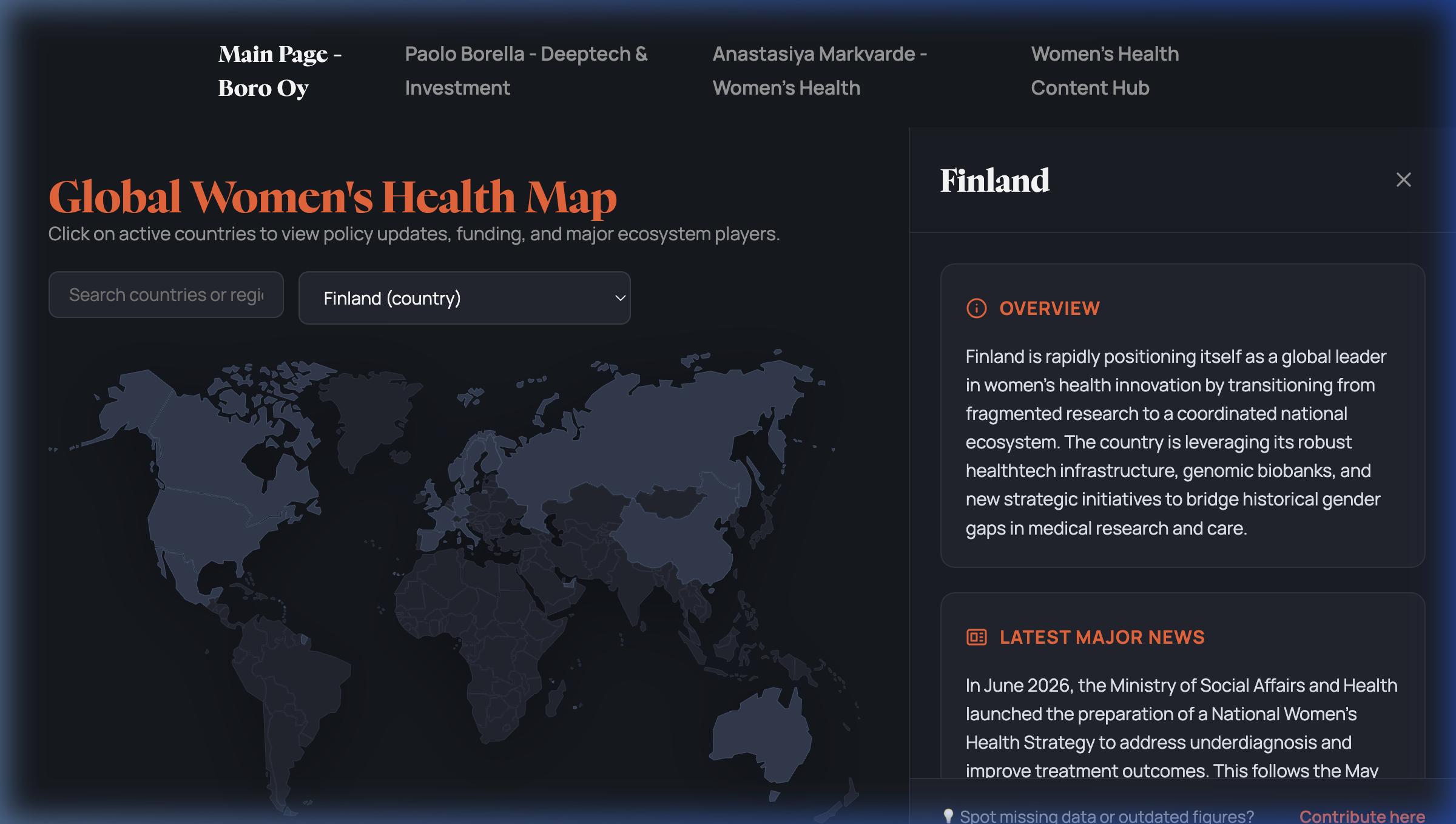
An interactive women’s health innovation map covering selected countries and regions. It brings together policy developments, funding rounds, investors, and major ecosystem organisations, with data updated quarterly.
Eir Accelerator · Women’s Health Hub Finland · Business Turku
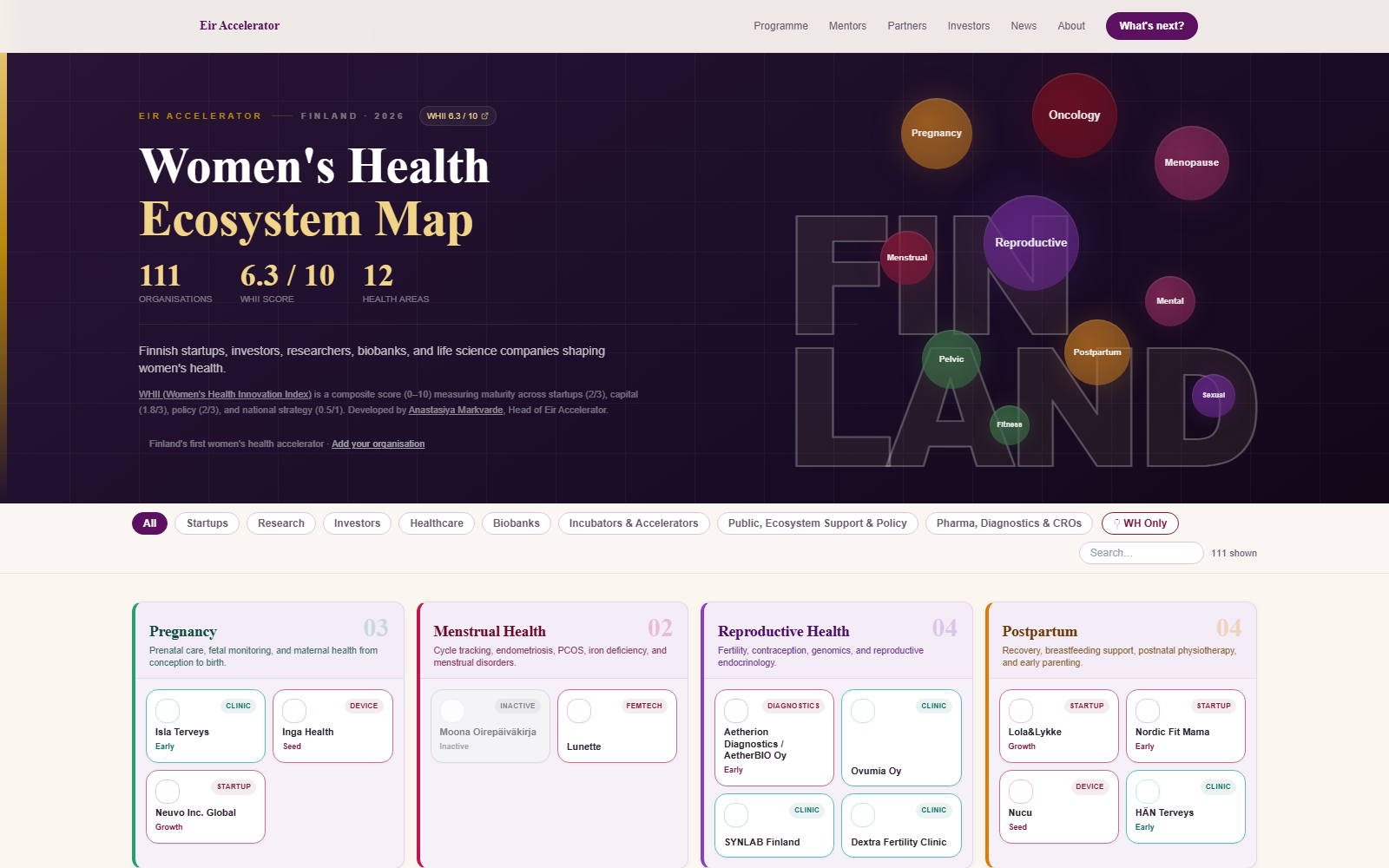
Finland Women’s Health Ecosystem Map
An interactive map of 111 Finnish organisations active across 12 women’s health areas. It covers startups, research, biobanks, investors, healthcare, pharma, and public and ecosystem support organisations.
The Red Report 2025, prepared by Supesu, focuses on menstrual and menopausal health in the workplace, as well as access to personal hygiene products in public spaces. Based on a survey of 162 employees across various business sectors, the report highlights the growing awareness and need for introducing menstrual and menopausal leave policies.
The report focuses on the campaign “In the Women’s Interest. Without Exception.” run by Gedeon Richter Polska, which aims to improve access to gynecological prevention and care for all women in Poland, especially addressing social, emotional and geographic barriers that prevent regular intimate health check-ups.
The White Paper on Menopause presents menopause as a natural yet socially neglected stage of women’s lives that has significant health, professional, and economic consequences, highlighting the scale of the phenomenon in Poland, its impact on the labour market, the healthcare system, and quality of life, as well as entrenched stereotypes and taboos that deepen the lack of support.
Blueprint to Close the Women’s Health Gap: How to Improve Lives and Economies for All
Developed by the World Economic Forum in collaboration with the McKinsey Health Institute, this strategic blueprint outlines key actions needed to close the women’s health gap, enhance quality of life, and drive global economic growth.
Produced by Springboard Enterprises and Accenture, this report identifies three key barriers to women’s health — underfunding, research gaps, and misaligned understanding of women’s health needs — and presents actionable, system-level solutions.
The National Knowledge Test on Sexual Education report, prepared by the SEXEDPL Foundation and DOZ.pl, is a nationwide study assessing the knowledge of Polish women and men about sexuality and sex education. While most respondents rated their knowledge highly, test results revealed significant gaps — only 16% achieved a good or very good score.
The National Health Test of Poles 2024 is the fifth edition of Poland’s largest study on public health, lifestyle, and health attitudes. Over 150,000 people took part in the latest edition, and since 2020 more than 1.3 million surveys have been collected.
Invisible at Work: Women in the Perimenopausal Period
An Ipsos study commissioned by Kulczyk Foundation examines how menopausal transition symptoms affect women’s comfort, performance, and employment decisions in Poland, and identifies workplace measures that can provide meaningful support.
Sie Ventures has created the first comprehensive map of the European FemTech market, based on data from over 540 active companies across all stages of development — from pre-seed startups to publicly listed firms.
Closing the Women’s Health Gap: A $1 Trillion Opportunity to Improve Lives and Economies
Developed by the World Economic Forum in collaboration with the McKinsey Health Institute, this report analyzes the global women’s health gap, its economic impact, and proposes potential systemic solutions.
Prepared by FemHealth Insights, this report explores the FemTech landscape in 2023 — its growth, women’s health trends, the most dynamic areas of innovation, company exits, and forecasts for 2024.
Published by Calm/Storm VC, this comprehensive report provides an overview of the FemTech industry — its current state, major challenges, and areas of underinvestment. It also identifies the biggest opportunities for innovation in women’s health, including menopause, oncology, sexual health, fertility, and contraception.
The report Menopause Without Taboos is a comprehensive social study commissioned by the Kulczyk Foundation, examining the experiences, knowledge, and attitudes of Polish women and men toward menopause. The publication discusses the topic from biological-medical, social, and cultural perspectives, showing that menopause still remains a taboo subject.
The Gender Data Health Gap: Harnessing AI’s Transformative Power to Bridge the Gender Health Data Divide
This report by Women at the Table examines the gender data gap in health — its impact on diagnostics and treatment, and how AI could deepen existing inequalities. It also presents multidimensional systemic and technological solutions to address the issue.
This cross-sectional publication gathers data on women’s participation and rights across political, social, and private spheres. Experts from various fields present research, analyses, and trends, while offering recommendations for actions needed to improve standards and protect women’s rights.
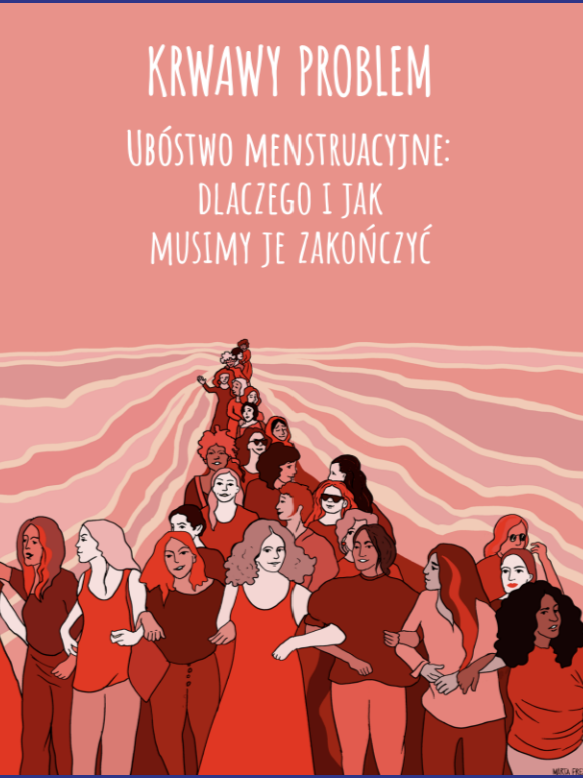
Prepared by the Kulczyk Foundation in cooperation with Founders Pledge, this report analyzes the global issue of limited access to menstrual hygiene products.